


World Migratory Bird Day 2026
Earlier this month, Deputy Director Heather Barrett teamed up with our Virginia friends at Waynesboro Parks and Recreation, the US Fish and Wildlife Service, and the Augusta Bird Club for several events around World Migratory Bird Day, including a talk from Heather herself!
World Migratory Bird Day is a global initiative devoted to celebrating migratory birds and for promoting their conservation worldwide. Shared observations, brought together through digital platforms and community science initiatives, are helping inform migratory bird conservation across borders and entire flyways. This year’s theme was “Every Bird Counts – Your Observation Matters” highlights the role community science, also referred to as citizen science, has in migratory bird conservation. By sharing the sighting of birds or participating in an established community science project, like local surveys, people around the world are providing valuable information that supports research, conservation, and policy. Anyone can help improve our knowledge and therefore the conservation of birds.
On October 10th, World Migratory Bird Day marked its second peak day of the year by celebrating the people whose observations help scientists and conservationists understand bird migration, track population changes, and identify important habitats across the world’s flyways.
“Migratory birds depend on many different habitats during their journeys, often across several countries. Safeguarding them requires coordinated action throughout their ranges and community science strengthens the shared evidence that countries need to work together effectively. Community science gives people a meaningful role in understanding and conserving the wildlife around them. It strengthens monitoring while also building public awareness, participation and a shared sense of responsibility for the future of migratory birds.” – Andy Raine, Executive Secretary, Convention on the Conservation of Migratory Species of Wild Animals (CMS)
Celebrated two days each year, to reflect the cycle of bird migration and varying peak migration periods in the northern and southern hemispheres, World Migratory Bird Day triggers hundreds of educational events around the world, united by their common goal of raising awareness and advocating for international bird protection.
BFREE collaborated on several events in Waynesboro, Virginia along the South River/South Fork Shenandoah River area to recognize the importance of full life cycle habitat conservation for Neotropical migratory songbirds. This is a continuation of multi-year collaboration between BFREE and the USFWS Virginia and is implemented with funding by the US Department of the Interior, Fish and Wildlife Service on behalf of the Dupont-Waynesboro Natural Resource Damage Assessment and Restoration Trustee Council – comprised of the US Fish and Wildlife Service and the Commonwealth of Virginia.




October 1 – 31, 2026
Migratory Bird Exhibitions at the Waynesboro Public Library
In collaboration with Waynesboro Parks and Rec and USFWS Virginia, BFREE installed two displays at the Waynesboro Country Library during the month of October. One was a glass case display that focused on the theme of citizen science supported bird research, the second was a wall exhibit that showed the connection between Belize’s and Virginia’s migratory birds.
Many of the materials used in this year’s table were created and/ or inspired by Environment for the Americas. Environment for the Americas connects people to nature and birds through research, education, and outreach. At the heart of our efforts is the coordination of World Migratory Bird Day across the Americas, an initiative that engages people of all ages in the protection of our shared migratory birds.
October 10-11, 2026
Migratory Bird Exhibit Table at Waynesboro Fall Arts Foliage Festival
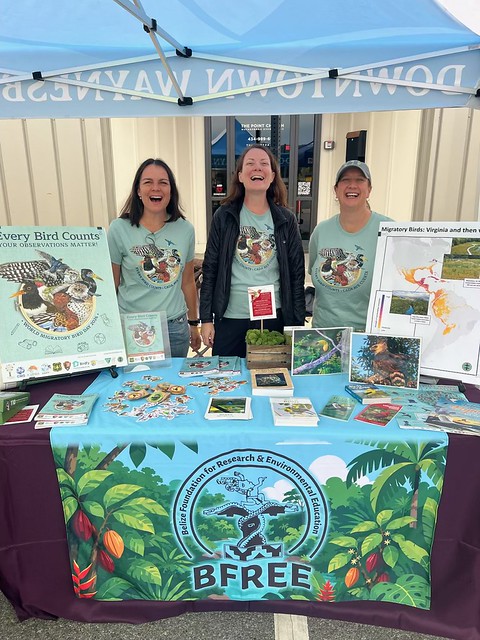
BFREE collaborated with Waynesboro Parks and Rec, US Fish and Wildlife Service and Augusta Bird Club to host three tables during the 55th Annual Fall Foliage Festival in Waynesboro, VA. This is the Shenandoah Valley’s largest outdoor are festival and it takes place in historic downtown Waynesboro, Virginia. This year’s event included 160 artists and artisans’ paintings, pottery, jewelry, woodwork, glass art, and more.
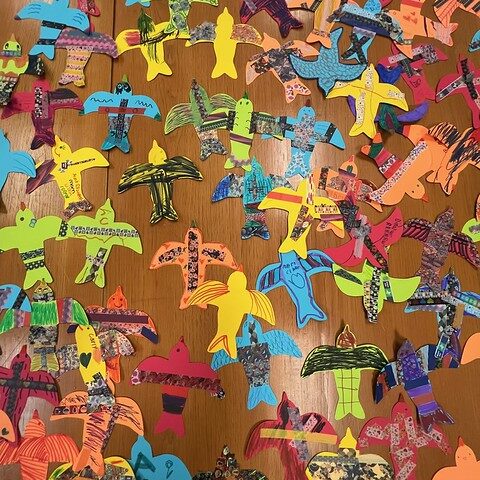
The three booths included a craft activity geared toward kids in which they decorated bird cutouts that were incorporated into the migratory bird display at the Waynesboro Public Library, an information table focused on World Migratory Bird Day and the connection between Virginia and Belize for Neotropical Migratory Songbirds, and a bird trivia table in which visitors were invited to answer questions under several different categories to win an embroidered patch or sticker featuring different migratory birds. Winners of the trivia were placed into a raffle to win a pair of binoculars. An adult winner and a child winner each received a pair of binoculars.
The team consisted of Waynesboro Parks and Rec Staff, USFWS Staff, BFREE staff, plus volunteers from the Augusta Bird Club. Team members consisted of: Stephanie Seltzer, Anne Condon, Allison Laciano, Heather Barrett, and Rich Wood.
October 13, 2026
“Wings across landscapes: How a Belize discovery sparked a conservation bridge to Virginia” presented by Heather Barrett, BFREE Deputy Director
Summary of Talk:
The BFREE Privately Protected Area and Biological Field Station lies at the foothills of the Maya Mountains in southern Belize, adjacent to the Bladen Nature Reserve: one of the world’s most intact tropical wilderness areas. For over 30 years, the field station has supported scientific research, environmental education, and conservation in this extraordinary landscape. This presentation follows two remarkable discoveries: a rare bird and a rare tree, which launched complementary, long-term research and conservation programs.
The rediscovery of the Harpy Eagle (Harpia harpyja), a species thought to have been extirpated from Belize for more than 60 years, led to an avian research program that documented the species while generating critical data on Neotropical migratory bird movements along the Eastern Flyway. The program mapped geographic lifelines connecting Belize’s tropical wintering grounds with North American breeding corridors, including migratory hubs such as Waynesboro, Virginia.
The identification of an heirloom variety of Criollo cacao (Theobroma cacao), an exceptionally rare cultural and biological resource, inspired BFREE staff to establish experimental cacao agroforests to investigate whether cultivated forest systems could provide habitat and foraging opportunities for migratory birds facing rapid habitat loss across the flyway. The work explored how cacao production might support local livelihoods while maintaining ecological connections within the forest landscape.
Together, the stories of the Harpy eagle and Criollo cacao demonstrate how global partnerships, local capacity building, sustainable livelihoods, and flyway-scale conservation can protect forests and the species and communities that depend on them.
