

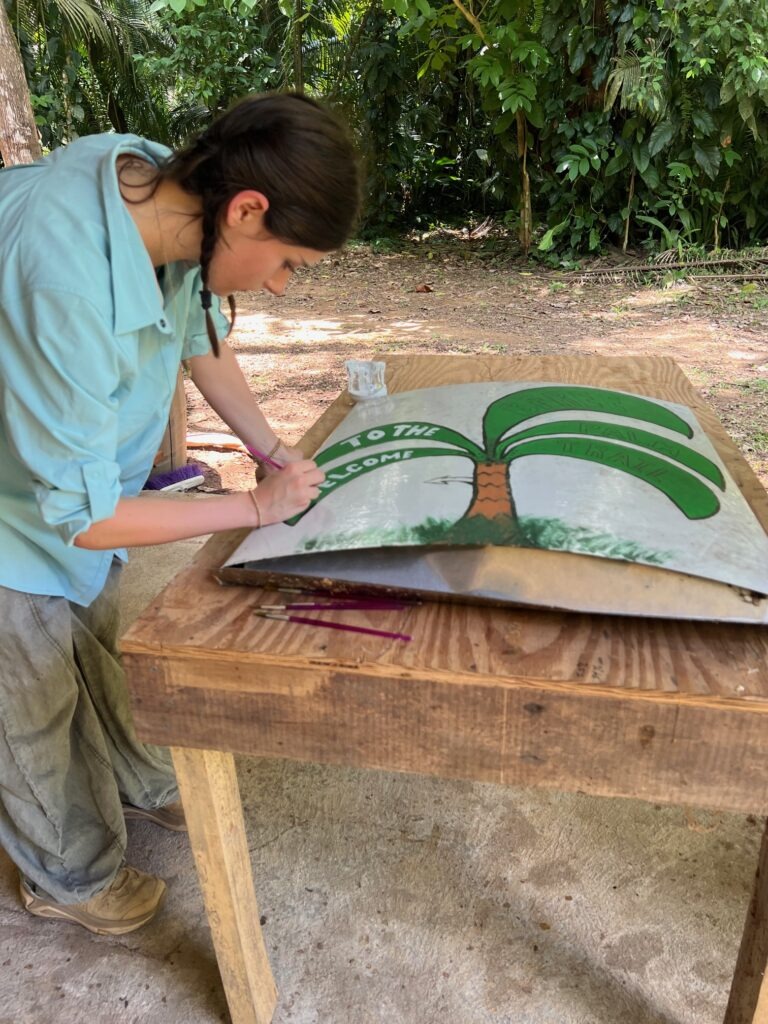
The Beauty of the Palm: An introduction to BFREE’s Palm Trail

By Mario Teul | BFREE Tour Guide & Educator
The natural landscape of Belize is so diverse. From the limestone Maya Mountains, the savanna coastal flood plains, to the rivers which flow from the mountains to the coast— are all unique habitats. One of the many diverse plant features of our natural landscape which has always fascinated me are the palms. Whether I am hiking in mature broadleaf forest, secondary disturbed forest, pine savanna, canoeing on a river, or even in a wetland area, there are palms of various species, sizes, shapes and height to be seen and appreciated. The flowers and fruits of these palms and even the many birds visiting them are appreciated for their natural beauty.
The idea of establishing an educational or interpretive palm trail at BFREE occurred to me some time ago. After hiking some of the areas devastated by the raging forest fires, I was surprised to note that palms of different species were one of the first among other pioneer plant species, to regenerate affected areas. It made me ask: Are palms highly resilient plants even after being scorched to their stump by fires? Palms do abound in the forests of BFREE, which has not been affected by fires in recent history. There are palms of the same species I see in other areas but there are also many unfamiliar ones which I became curious about and wanted to learn more about them.
I became determined to approach the BFREE Directors with the idea of establishing a Palm Trail at BFREE for several reasons. The primary goal to educate both local and international visitors to some of the many palm species we have in our diverse habitats. The second goal is to increase my knowledge on these palms. Even though I know and can identify some palm species, there is so much more to learn. Therefore, I approached the Directors about my intention and they were highly receptive to the initiative.
We selected a site within a mature broadleaf riparian forest. With the help of the Head Ranger (HR) who is also the Protected Areas Manager (PAM), we did a preliminary inventory of the existing palms in the selected site. We discussed what other palms exist either on BFREE property or its surrounding environs as the HR/PAM is highly knowledgeable, and came up with a list of what we can add to the trail that was reflective of what grows within the preserve and its proximity. Currently, we have 10 species positively identified (hopefully) as palms are challenging to identify. I have to rely extensively on various BFREE staff knowledge, which they readily share, and the limited resource available to continue with the identification and establishment of the trail. I also have the following few resources to be very useful for additional information and identification:
- Field Guide to the Palms of Belize by Michael J. Balick & Andrew Henderson;
- Common Palms of Belize by Samuel Bridgewater, Nancy C. Garwood, & Steven Brewer and the following website;
- https://.palmpedia.net>wiki>whatever plant I may be looking for.
Several of the palms I find very interesting are the Cohune and Chamaedorea Palms. The Cohune amazes me— I was surprised to learn that the single blades that shoots up above ground is at least more than 6 years old. The medicinal and other usage which this palm contains is very new information. I was also impressed to know that two out of the three Chamaedorea palms that are greatly over-harvested still flourish at BFREE and surroundings. It is the hope the work will continue on this project and that several more palm species of interest will be identified and added to the trail.

Fabulous article. Beautifully written. Absolutely inspiring. Yummy to read and enjoy while learning!❤️
Great work, Mario! Congratulations on your progress to highlight these beautiful and useful plants! I look forward to hiking the Palm Trail the next time I visit BFREE.